Sunday, September 8, 2024

The Problems and Factors That Are Related to the Success of Quality Management in Education


The Problems and Factors That Are Related to the Success of Quality Management in Education


1. Quality Management

Quality is described as "the entirety of a product or service's features and attributes that have an impact on its capacity to satisfy stated or implied needs."

According to Joseph Juran, quality is a standard, measurement or a degree that meets, satisfies or exceeds the needs or expectations of the customer in the view of it as fitness for purpose. It will be measured by the level of fulfillment of a desired purpose, mission or goal by a program, institution or organization.

There are five ways of thinking about quality, rather than definitions, that have been proposed by Harvey and Green (1993).  This typology provides a helpful framework for thinking about the subject and is regularly cited in the literature on higher education and by practitioners. Figure 1 shows Harvey and Green’s five ways of thinking about quality in higher education.

                Figure 1: Illustration of Harvey and Green’s five ways of thinking quality in higher education


Therefore, ‘Quality’ can be defined in many different ways according to the different contexts. It can be seen from different dimensions or perspectives. Quality can be either objective or subjective, depending on the definition used. Quality in higher education means the educational process is such that it ensures students achieve their goals and thereby satisfies the needs of the society and help in national development (Mishra, 2006).

Quality in education is defined by different factors such as having adequate infrastructure and tools in the classroom that generate an optimal environment for the development of academic activities, having trained teachers with both specific knowledge and pedagogical skills to ensure that all students receive and assimilate the same information depending on their particular needs, and providing students with techniques, strategies and skills that allow them to be an active part of the construction of their knowledge (Gamboa-Suárez, Avendaño-Castro, & Núñez, 2022).

Quality education requires quality management. The word quality means conformance to specification and fitness for purpose or use or use with zero defects. Quality management in education should be focused on implementing innovations, evaluating human talent and redesigning educational methodologies, according to the American Association of Quality Management Organization.

Various models are used to achieve efficient organizational management and  one of those is quality management system. Quality management requires a structure, procedures, processes, and other resources. The success of education in terms of quality depends not only on all ministry agents, from teachers to local and central government officials, but also on the parents of the students - particularly through the establishment of special management and/or regulatory mechanisms in the school, as well as their participation in the financing of certain resources, and on civil society stakeholders who can plan and mobilize resources to support schools.

Additionally, it should be noted that the systemic dimension of quality arises from the effective and efficient implementation of the key organizational and management responsibilities of the educational system, including planning, human resource management, curricula and syllabi, school management, financial resource management, evaluations, and information systems. More specifically, educational quality management can be described as a series of coordinated actions between various levels of an educational system that are intended to produce information and decisions in order to achieve the desired results in accordance with a framework, with a crucial focus on equity.

Fundamentally, the management of education of a country directly affects its economic and developmental life. Because of this, developed countries pay more attention to their education systems' management (Kaul, 2010). Educational management relates to the activities and management of educational organizations (Lange, 1988). In accordance with this, a country's management of its educational system has a significant impact on the development and overall success of the country. In light of the aforementioned, effective management of the educational system is crucial and has a significant impact on the quality of the labor force and the nation as a whole, as well as the long-term expansion of the national economy (Cho & McLean, 2004; McLean, 2006; Peters, 2009).

2. Problems and factors that affect the success of Quality Management

Quality management is not an easy management concept to apply to educational institutions since academic cultures are frequently resistive to change and hostile to efforts at improvement. Total quality management perspectives are appropriate and ideal in industry, according to (Claude Ah-Teck & E. Starr, 2014), but the viability and value in education still need to be discussed. Some educators also think that business-oriented mentality may not be appropriate for service organizations like educational institutions (Sohel-Uz-Zaman & Anjalin, 2016).

The biggest obstacle to implementing quality management in education is the lack of commitment on the part of individuals working in the system, particularly senior management and instructors. The lack of management support prevents process improvement, which in turn is hindered. According to (Brown, 1992), a lack of commitment from top management can negatively affect the implementation of quality management efforts, and this can lead to the main reason for the failure of quality management efforts. Bayraktar, Tatoglu and Zaim (2008) and Kosgei (2014) also stated that some of the challenges in implementing quality management in schools come from a lack of commitment by management, some of the workforce, school organizational culture, poor documentation, inadequate staff training, and ineffective communication.

Many academics think that the quality of education is declining, and they're having a lot of trouble with unhappy customers and low employee morale. Quality Management is seen as a way to improve things, and it has turned into a kind of managerialism because of the different ways of being applied to different kinds of organizations in different parts of the world. However, there are some problems with applying quality management techniques to education, which can be expected to happen. Poor input, poor service delivery, a disregard for performance and measurement standards, an unmotivated workforce, and a failure to prioritize student skills can all contribute to the failure of quality management in education (Gomes & Panchoo, 2017; King, 2013).

There are also some critical obstacles, such as ineffective leadership, obstacles to change, contradictory policies, and inappropriate organizational structure in implementing quality management in schools. The other reasons why institutions that want to practice quality management often fail are that administrators are not committed to the idea of quality, there are no effective communication channels, it is hard to measure the results of an institution's work, there is a bureaucratic decision-making circuit, and there is not much leadership support.

Higher education institutions have long been considered the source of high-quality concepts, but have been slow to adopt quality management practices. There are a number of reasons for this, including different stakeholder perspectives and institutional quirks. Quality management in higher education is a challenging endeavor, due in part to the many different factors at play.

According to numerous researches about challenging problems of implementing quality management in education, the common problems and obstacles are shown as follows in a Figure 2.


       Figure 2: Diagram of common problems and factors that affect the success of Quality Management


3. Quality Management Implementation

The academic culture in educational organizations is resistant to change and often opposed to any attempts at improvement, and as a result, quality management becomes a challenging management strategy to implement.

Quality management and resources are necessary for a high-quality product. According to (Dhal, 2021), the following figure shows the stages that could be useful as a potential planning sequence to be used at any educational institution for quality management. The first step in this path is to create a vision and mission for quality that focuses meeting the needs of students, community involvement in quality improvement programs, and continual progress towards excellence in educational services and educational products. In order to make strategic corporation plans according to quality policies and measures, market analysis and SWOT analysis are to be conducted as the following steps. All those stages focusing on the quality value must be finally accompanied by evaluation process with the feedback from all who have involved throughout the strategic planning.


Figure 3: Diagram of Strategies of Quality Management

Dale and Oakland (2000) claim that dedication and leadership, planning and organizing, implementing and training quality management in education, everyone's engagement, cooperation, evaluation and feedback, and working together are the keys to adopting quality management. In general, the core values presented by Bergman and Klefsjö (1994); Kennerfalk, (1995); Kanji, Malek and Tambi (1999) are: focus on customers, the participation of all parties, focus on the process, continuous improvement and decision based on facts.

Focus on customers: There are two groups of people who often interact with schools: internal customers, who are students, employees (teachers, staff) and/or organizers working within the school system, and external customers, who are people who rely on the school system for services, such as the community, government, and industry. Quality management believes that it is important for organizations to always be listening to their customers, in order to ensure that they are providing the best possible service. If an organization's quality of service is poor, however, the customer will be dissatisfied.   

Focus on the process: The relationship between customers and internal and external suppliers is mediated by the process. The purpose of a process is to provide a product that satisfies its customers and is supported by an organization that has adequate human resources and the necessary tools (Pall, 1987).

Participation of all parties: According to (Wilkinson, 1998), the improvement of school quality is a shared duty in the field of education, requiring the participation of all stakeholders, not only school administrators. Every student's participation will boost their sense of responsibility, creativity, cooperation, duties, trust, and self-control.

Continuous Improvement: Quality management is now known as "new managerialism." This means that schools are more committed to achieving quality improvement and generating sustainable progress. Continuous improvement encourages schools to keep working to improve their conditions, meeting the expectations of all parties by regularly analyzing the school situation and creating effective ways to improve things with the PDCA cycle by Deming (1993).

Decisions based on facts: Quality management encourages organizations to collect and analyze data to make sure that decisions in schools are based on factual information rather than arbitrary variables, in order to create decisions or policies that are accurate and right on target (Deming, 1993; Ishikawa, 1986).


Figure 4: Diagram of the summary of implementing quality management


4. Conclusions

Education is the one, which is essential to all the people in different parts of the world. People want to make sure that the education they get or that they give their children is of a high quality. This is especially important in a competitive education sector where success of an academic institution depends on the quality of education. Consequently, the quality and management of education, having a significant impact on economic growth, is regarded as one of the most important factors for all the countries, in order to maintain and strengthen competitiveness in the world of globalization.

Quality management is gaining popularity among educators, policy makers, scholars, and researchers since it has been proven to be an applicable and effective management philosophy for customer satisfaction, continuous improvement, and organizational excellence. Quality Management in education will produce better results in all aspects of the educational process because it is a good management technique that has proven to produce excellent results in other industrial and business organizations (Akhtar, 2000).

Quality management can be a difficult process to implement, and there are several problems that have been noted in different studies. To be successful with the implementation of quality management, everyone in the institution must be committed to quality, and this commitment must be continuous and shared. The managing committee, principal, teachers, students, non-teaching staff, and parents all need to be on board and work together to ensure quality is maintained.

As a result, quality management can assist schools and colleges in improving their primary customers, students and employers since its emphasis on continuous improvement is a fundamental way of meeting the accountability requirements that are common in educational reform. Quality management system that focuses on continuous growth and improvement provides students and teachers with a more exciting and challenging learning environment than a "good enough" system can. Based on the participatory management philosophy, quality management encourages students, teachers and community stakeholders to perform excellent tasks. This is because a quality management is designed to always be searching for ways to improve, which makes it more effective and exciting for all the participants. 


References

Akhtar, M. S. (2000). Total Quality Management (TQM) and Its Implementation in Education in Pakistan. Journal of Elementary Education, 10(2), 29–43.

Bayraktar, E., Tatoglu, E., & Zaim, S. (2008). An instrument for measuring the critical factors of TQM in Turkish higher education. Total Quality Management & Business Excellence, 19(6), 551–574. https://doi.org/10.1080/14783360802023921

Bergman, B., & Klefsjo, B. (1994). Quality: From Customer Needs to Customer Satisfaction. Student Litterateur, Lund.

Brown, A. (1992). TQM: IMPLICATIONS FOR TRAINING. Industrial and Commercial Training, 24(10). https://doi.org/10.1108/00197859210022789

Cho, E., & McLean, G. N. (2004). What We Discovered about NHRD and What it Means for HRD. Advances in Developing Human Resources, 6(3), 382–393. https://doi.org/10.1177/1523422304266090

Claude Ah-Teck, J., & E. Starr, K. (2014). Total Quality Management in Mauritian education and principals’ decision-making for school improvement. Journal of Educational Administration, 52(6), 833–849. https://doi.org/10.1108/jea-06-2012-0075

Dale, B. G., & Oakland, J. S. (2000). Quality Improvement Through Standards. Stanley Thorne.

Deming, W. E. (1993). Total Quality Management in Higher Education (Vol. 35, pp. 18–20). Management Services.

Dhal, P. K. (2021). Quality Management in Education. SSRN Electronic Journal. https://doi.org/10.2139/ssrn.3726921

Gamboa-Suárez, A. A., Avendaño-Castro, W. R., & Núñez, R. P. (2022). EDUCATIONAL QUALITY MANAGEMENT IN LATIN AMERICA. Journal of Language and Linguistic Studies, 18(2). Retrieved from http://www.jlls.org/index.php/jlls/article/view/4263

Gomes, T., & Panchoo, S. (2017). TQM in Private Secondary Education in Mauritius. International Journal of Innovation and Research in Educational Sciences, 4(4), 421–432.

Harvey, L., & Green, D. (1993). Defining Quality. Assessment & Evaluation in Higher Education, 18(1), 9–34. https://doi.org/10.1080/0260293930180102

Ishikawa, K. (1986). Guide to Quality Control 2nd Rev Quality Resources. White Plains.

Kanji, G. K., Malek, A., & Tambi, B. A. (1999). Total quality management in UK higher education institutions. Total Quality Management, 10(1), 129–153. https://doi.org/10.1080/0954412998126

Kaul, J. N. (2010). Higher education, social change and national development. Retrieved from http://14.139.58.196:8080/xmlui/handle/123456789/169

Kennerfalk, L. (1995). Changes in organizational structure related to the implementation of a total quality management strategy. Ltu.diva-Portal.org. Retrieved from http://urn.kb.se/resolve?urn=urn:nbn:se:ltu:diva-26308

King, Dr. N. A. S. (2013). Investigation of Factors Hindering Quality Education in Secondary Schools in Mbeya, Tanzania. International Journal of Learning and Development, 3(6), 52. https://doi.org/10.5296/ijld.v3i6.4843

Kosgei, J. M. (2014). Challenges Facing the Implementation of Total Quality Management in Secondary Schools: a Case of Eldoret East District, Kenya. Global Journal of Human Resource Management, 3(1), 12–18. www.eajournals.org. Retrieved from www.eajournals.org.

Lange, D. B. (1988). Tomorrow’s schools: the reform of education administration in New Zealand.

McLean, G. N. (2006). National Human Resource Development: A Focused Study in Transitioning Societies in the Developing World. Advances in Developing Human Resources, 8(1), 3–11. https://doi.org/10.1177/1523422305283054

Mishra, Dr. S. (2006). Quality Assurance in Higher Education (pp. 50–51). NAAC.

Pall, G. A. (1987). Quality Process Management. Prentice Hall.

Peters, A. A. (2009). Population and Human Resource Development in Nigeria. Lecture delivered at the National Defence College. Abuja Nigeria to Participants of Course, 18(7).

Sohel-Uz-Zaman, A. S. Md., & Anjalin, U. (2016). Implementing Total Quality Management in Education: Compatibility and Challenges. Open Journal of Social Sciences, 04(11), 207–217. https://doi.org/10.4236/jss.2016.411017

Wilkinson, A. (1998). Managing with total quality management: theory and practice. Basingstoke: Macmillan Business.

Contemporary Concepts and Trends in Educational Management and Leadership for Post-Pandemic Education 

The Covid-19 pandemic has had a drastic impact on educational leadership around the world. In the wake of the pandemic, educational institutions have had to quickly adapt to the new realities of online learning and social distancing, as well as the need for greater collaboration and innovation. As a result, there has been a shift towards new concepts and trends in educational leadership that are better suited to the post-pandemic educational landscape. 


Distributed Leadership 

One of the most significant changes in educational leadership is the shift towards distributed leadership. With the rapid closure of schools and universities around the world, many educational institutions have had to quickly adjust to the new reality of virtual learning and the need for more collaborative and innovative approaches to leadership. This shift has forced educational institutions to invest in new digital infrastructure and online learning platforms, as well as to develop innovative ways to engage students in a digital classroom. Distributed leadership is an approach to educational leadership that focuses on decentralizing authority and decision-making. It is based on the idea that knowledge and expertise are not limited to one individual and can be found among a larger group of people. This concept has been gaining traction in recent years, as educational institutions have become more complex and diverse, requiring more collaboration and innovation. 

The concept of distributed leadership has its origins in the work of educational reformers such as John Dewey, who argued for a shift away from the traditional top-down model of educational leadership. The theory of distributed leadership was further developed by James MacGregor Burns in the late 1960s, and since then, has been further explored and refined by other theorists. 

Distributed leadership has had a profound impact on educational institutions. It has enabled educational institutions to take a more collaborative and innovative approach to decision-making, and to better leverage the knowledge and expertise of all stakeholders. This has allowed educational institutions to better respond to the rapidly changing needs of their students and to develop more effective and equitable practices. 

The pros of distributed leadership include greater collaboration and innovation, better decision-making, and improved responsiveness to changing needs. The cons include the need for additional resources and training for distributed leadership to be effective and the potential for distributed authority to be misused. 

In conclusion, distributed leadership has become an increasingly important concept in educational leadership, as educational institutions have become more complex and diverse. This approach has enabled educational institutions to take a more collaborative and innovative approach to decision-making, and to better leverage the knowledge and expertise of all stakeholders. While there are potential drawbacks to distributed leadership, its potential benefits make it a valuable tool for educational institutions today. 


Data-driven Decision Making 

Another important trend in post-pandemic educational leadership is the increased focus on data-driven decision-making. Data-driven decision-making involves the use of data and analytics to inform educational decisions and policies, and it is becoming increasingly important as educational institutions strive to keep up with the rapid changes in the world. Additionally, the use of technology for personalized instruction and assessment is also growing in popularity, as it offers a more efficient and cost-effective way to track and assess student progress. 

Data-driven decision making is a process of making decisions based on data and analytics. It is a method of analysis that uses evidence-b ased data to inform decisions and policies in the education sector. 

The concept of data-driven decision making has its roots in the management sciences, particularly in the fields of operations research and management science. In the late 1960s, the term “data-driven decision making” was first coined by Peter Drucker, and since then, it has been further developed and refined by other theorists. 

Data-driven decision making has had a profound impact on educational institutions. It has enabled educational institutions to take a more systematic and evidence-based approach to decision-making, allowing for better informed decisions and policies. This has allowed educational institutions to better respond to the rapidly changing needs of their students and to develop more effective and equitable practices. 

The pros of data-driven decision making include more informed decisions, greater efficiency, and cost effectiveness. The cons include the need for additional resources and training for data-driven decision making to be effective and the potential for data to be misinterpreted or misused. 

In conclusion, data-driven decision making has become an increasingly important concept in educational leadership, as educational institutions have become more complex and diverse. This approach has enabled educational institutions to take a more systematic and evidence-based approach to decision-making, allowing for better informed decisions and policies. While there are potential drawbacks to data-driven decision making, its potential benefits make it a valuable tool for educational institutions today. 


Collaborative-oriented Leadership


Collaborative-oriented leadership styles involve a more collaborative approach to decision-making and problem-solving, where multiple stakeholders are involved in the process (Leinwand et al., 2021). This kind of leadership is intended to be more inclusive and to enable people and groups to cooperate in order to accomplish a common objective. It emphasizes on fostering relationships and trust among team members as well as developing a shared vision. Leadership and management in education are significantly impacted by collaborative orientation. It promotes a more team-based method of decision-making, which can result in better decisions and more efficient problem-solving (Leinwand et al., 2021). Additionally, it enables a more welcoming environment where all participants in the process are given a voice and are active. This may result in more employee commitment, motivation, and morale as well as improved staff-student interaction and collaboration (Leinwand et al., 2021). In conclusion, collaborative leadership styles can significantly improve educational management and leadership. The possible drawbacks of this leadership approach must be taken into account, and it is crucial to include all relevant parties in the decision-making process. Organizations can promote an inclusive atmosphere and a collaborative and trustworthy culture by embracing collaborative-oriented leadership styles. As a result, there may be better communication, higher morale, and wiser choices.

To sum up, it can be said that the Covid-19 pandemic has had a profound effect on educational leadership all over the world. Educational institutions have been forced to fast adapt in light of the reality of online learning and social isolation by looking at fresh ideas and trends including distributed leadership, data-driven decision-making, and collaborative-oriented leadership.


References


Drucker, P. (1968). The Practice of Management. New York: Harper & Row. 


Kantor, R. (2006). Data-Driven Decision Making: The Power of Data-Driven Decision Making. Journal of Educational Administration, 44(1), 7-34. 

Leinwand, P., Mani, M. M., & Sheppard, B. (2021). 6 Leadership Paradoxes for the Post-Pandemic Era [1]. Harvard Business Review Press.

Mintzberg, H. (1979). The Structuring of Organizations. Englewood Cliffs, NJ: Prentice Hall.
 
Tornatzky, L. G., & Klein, K. J. (1982). Innovation Characteristics and Innovation Adoption-Implementation: A meta-analysis of findings. In R. A. Burgelman (Ed.), The Process of Technological Innovation (pp. 167-213). Lexington, MA: Lexington Books. 


The Impact of Covid-19 on Education: Contemporary Concepts and Trends of Education in Post-Pandemic Education


The impact of COVID-19 pandemic on education has been profound and long-lasting (Meinck, Fraillon, & Strietholt, 2022).  In the wake of the pandemic, educational institutions around the world have had to quickly adapt to the new realities of online learning and social distancing. As schools and universities strive to provide quality education in a safe environment, they are exploring new concepts and trends to ensure a smooth transition to the post-pandemic educational landscape. These changes make contemporary concepts and trends in post-pandemic education emerge. These concepts and trends will help to ensure that education continues to evolve and meet the changing needs of students in a post-pandemic world. UNESCO (2020). This article will explore some of the most well-liked theories and educational trends, with special focus on how they affect education and its benefits and drawbacks.


One of the most significant changes brought about by the pandemic is the shift towards digital education and online learning. With the rapid closure of schools and universities around the world, many institutions had to quickly adjust to the new reality of virtual learning. This shift has forced educational institutions to invest heavily in digital infrastructure and online learning platforms, as well as to develop innovative ways to engage students in a digital classroom. Online learning and digital education both refer to the delivery of educational information, instruction, and evaluation through digital technology. Due in large part to the COVID-19 epidemic, which precipitated a sharp shift to remote learning, digital education has been increasingly popular in recent years. Students can now access educational materials, instruction, and assessments from any location in the world without the need for a physical classroom or teacher thanks to digital education. Both in terms of access and learning quality, digital education has had a significant impact on the educational system. For instance, thanks to digital education, students can now access learning materials from anywhere in the world, enhancing educational chances for people who might not have had access to traditional learning settings. Additionally, digital education has increased options for collaboration and communication between students and teachers, as well as allowed for greater personalization of educational content and instruction. However, digital education also has its drawbacks. For example, there can be issues with technical difficulties such as slow internet connections or problems with digital devices. Additionally, digital education can lead to feelings of isolation and disconnection from peers, as well as from the teacher. Overall, digital education has had a profound impact on the education system, allowing for greater access to educational opportunities and more personalized instruction. However, there are also drawbacks to digital education, such as technical difficulties and feelings of isolation, which need to be addressed in order to ensure that students are able to benefit from the advantages of digital education. UNESCO (2020). Making data accessible for the COVID-19 pandemic [1]. 


Another key trend in post-pandemic education is the increased focus on personalized learning. Personalized learning is an educational approach that focuses on tailoring instruction to meet the individual needs of each student. In a personalized learning environment, teachers can use data and technology to create individualized learning plans for each student, providing them with instruction and assessments that are tailored to their abilities, interests, and learning needs. The educational system has been greatly impacted by personalized learning, which has allowed teachers to concentrate on the requirements of each individual student in their class. This has allowed students to be more engaged and motivated in the classroom, as they are able to focus on tasks that are specifically designed for their needs and interests. The ability to provide each student a customized lesson without having to spend time making lesson plans for the entire class has also allowed teachers to use their time more effectively. The technology required to generate tailored learning plans for each student in a class as well as the demand for personalized learning can make it difficult for teachers to implement personalized learning. Additionally, because it necessitates the purchase of materials and technology that may not be offered in all schools, individualized learning can be costly. The educational system has benefited overall from personalized learning, which has made it possible to provide each student with more individualized training and evaluation. It is crucial to remember that personalized learning can be difficult and expensive for instructors to execute, and that it requires careful preparation and implementation to be effective (UNESCO ,2020). 


The greater emphasis on bite-sized learning is another significant development in post-pandemic education. Bite-sized learning, also referred to as microlearning, is a learning approach that focuses on delivering small amounts of content in short, easily digestible chunks (Beddow, 2016). This approach is designed to make it easier for learners to absorb the material, as it breaks the content down into smaller pieces that can be processed more quickly and easily. Additionally, bite-sized learning also allows for more flexibility and autonomy, as learners are able to take the content in their own pace without having to commit large chunks of time to the learning process (Jones & Sandefur, 2015). The primary benefit of bite-sized learning is that it is more engaging and effective than traditional methods of instruction. By breaking the content down into smaller chunks, learners are able to more easily absorb the material, as they are able to focus on one concept at a time. Additionally, bite-sized learning allows for more autonomy, as learners are able to take the content in their own pace without having to commit large chunks of time to the learning process. On the other hand, there are some drawbacks to bite-sized learning. For example, learners may find it difficult to remember the content if they are not able to review it multiple times. Additionally, it can also be challenging for teachers to design effective bite-sized learning activities that are engaging and effective. Overall, bite-sized learning is a powerful method of instruction that can be highly effective when used properly. By breaking the content down into smaller chunks, learners are able to more easily absorb the material, and it allows for more flexibility and autonomy. However, it is important to note that bite-sized learning requires careful planning and implementation in order to be effective, and that it can be challenging for teachers to design effective activities (Beddow, 2016; Jones & Sandefur, 2015).

Additionally gaining popularity is homeschooling. Homeschooling is a form of education in which children are taught in the home rather than attending public or private schools (Freeman, 2019). It is typically chosen by parents who wish to provide their children with an alternative to traditional schooling, or who prefer to have more control over the curriculum and learning environment (Freeman, 2019). Depending on the way parents take and the resources at their disposal, homeschooling has a variety of effects on education (Weir, 2020). In general, homeschooling can give kids a highly customized educational experience that is catered to their unique requirements and learning preferences (Weir, 2020). Additionally, it enables parents to take a more active role in their kids' education and to foster a more comprehensive, family-centered learning environment (Weir, 2020). Homeschooling is an educational option in which children are taught in the home rather than attending public or private schools (Freeman, 2019). It is typically chosen by parents who wish to provide their children with an alternative to traditional schooling, or who prefer to have more control over the curriculum and learning environment (Freeman, 2019). The impact of homeschooling on education is varied, depending on the approach taken by the parents and the resources available to them (Weir, 2020). Generally speaking, homeschooling allows for a highly personalized learning experience that is tailored to the individual needs of the child (Freeman, 2019). It also allows parents to be more involved in their children’s education, and to provide a more holistic, family-oriented approach to learning (Weir, 2020). The advantages of homeschooling include the provision of a personalized learning experience tailored to the individual needs of the child, increased parental control over the curriculum and learning environment, and a family-oriented approach to learning (Freeman, 2019; Weir, 2020). However, homeschooling also has some disadvantages. These include the potential for parents to lack the knowledge or resources to provide an adequate education (Weir, 2020), the possibility of children missing out on essential socialization opportunities (Weir, 2020), and the potential for homeschooling to leave children unprepared for college or the workforce (Freeman, 2019).

In conclusion, the Covid-19 pandemic has had a profound impact on global education. In response to the new realities of online learning and social distancing, educational institutions around the world have had to quickly adapt by exploring new concepts and trends, such as digital education, personalized learning, virtual reality, and the development of soft skills 


References

Beddow, P. (2016). Professional socialization in social work: the impact of supervision. Social Work Education, 35(3), 277-289.

Freeman, C. (2019). The pros and cons of homeschooling. Education and Parenting Magazine. 

Jones, K., & Sandefur, S. (2015). Microlearning: A new approach to teaching and learning. Journal of Teaching and Learning, 10(2), 189-198 

Meinck, S., Fraillon, J., & Strietholt, R. (2022). The impact of the COVID-19 pandemic on education: international evidence from the Responses to Educational Disruption Survey (REDS). Retrieved from Unesco.org website: https://unesdoc.unesco.org/ark:/48223/pf0000380398.

UNESCO. (2020). Education in a Time of a Crisis: The impact of COVID-19 on education system. Retrieved January 2, 2023, from https://en.unesco.org/themes/education-2030/covid-19/education-in-a-time-of-crisis-the-impact-of-covid-19-on-education-systems. 

UNSD — Committee for the Coordination of Statistical Activities. (n.d.). Retrieved from unstats.un.org website: https://unstats.un.org/unsd/ccsa/.

Weir, L. (2020). The pros and cons of homeschooling. Scholastic 


Saturday, December 3, 2022

00. Welcome to exchange Knowledge


Welcome everyone interested in education or in-depth educational administration(Educational Concepts and Theories, Concepts in Educational Administration, and Policy & Strategic Management). Please come to exchange and learn in this room. The material that should be presented should be related to the concepts of education, educational theory, educational administration, strategic management, etc.

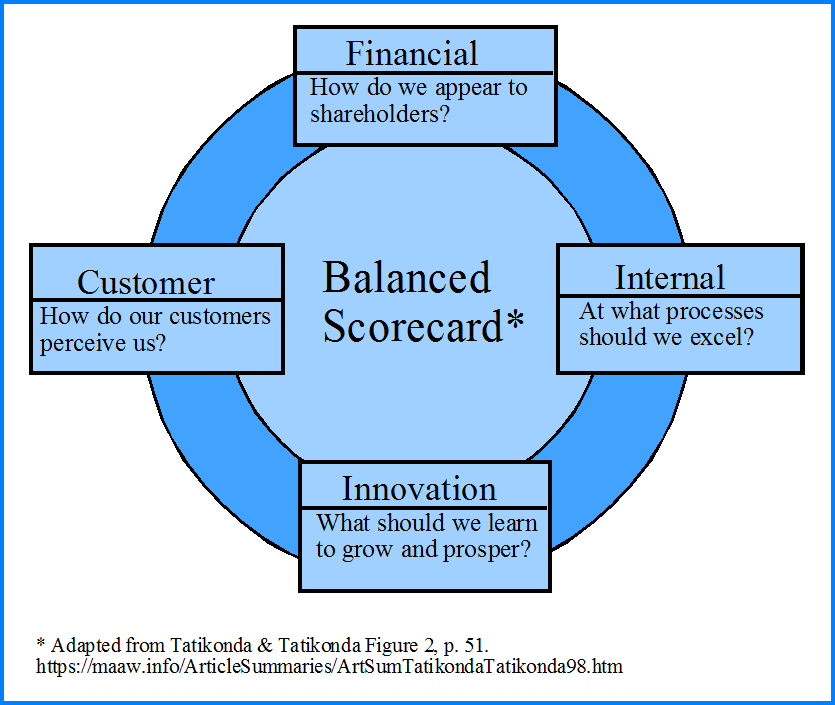
The Balanced Scorecard; Analytical View

The Balanced Scorecard is a Management System developed by  Prof. Robert S. Kaplan and Dr. David P. Norton of Harvard Business School in 199...